
Financial controlling
SAF-T Standardizes Data. Not Group Control.
Sumledger · June 9, 2026
SAF-T can improve accounting data structure. CFOs still need mapping, eliminations, traceability and control across entities.

From 1 January 2027, SAF-T Financial 1.40 becomes mandatory in Norway. For CFOs and controllers, it is a useful reminder: more structured accounting data improves finance work, but it does not solve group reporting on its own.
SAF-T is about standardized exchange of accounting data. It can make data easier to extract, inspect and use across systems. But a private group with several companies still needs a way to compare, map, explain and follow up numbers at group level.
That is the difference between source data and a control layer.
Short Answer: SAF-T Gives Structure, Not Group Control
SAF-T can make accounting data more standardized and available. But group control still requires finance-owned rules for account mapping, dimensions, eliminations, exceptions, voucher traceability and reporting packages across companies and accounting systems. Standardized data is a better starting point, not a finished month-end process.
For CFOs, the practical question is: what becomes easier when source data improves, and what does the finance team still need to control itself?
Scenario: Four Companies, Three Systems And One Reporting Deadline
Imagine a private group with four companies in Norway and Sweden. Two use the same ERP instance. One uses another accounting system after an acquisition. The Swedish company uses Fortnox. The group reports monthly to the board and quarterly to the bank.
The controller now gets better source data. Exports are more structured. More vouchers have better metadata. Accounts and transactions can be extracted more consistently than before.
Still, the finance team faces the same group-level questions at month-end:
- Which accounts map to the same group reporting line?
- Which dimensions are actually comparable across companies?
- Which intercompany items should be eliminated?
- Why is margin below budget in one entity?
- Which transactions and vouchers explain the movement?
- Which reporting package is right for the board this month?
SAF-T can make it easier to access better data. It does not decide how the group should be managed, explained or reconciled.
What SAF-T Can Improve
Standardization has real value. For finance teams working across companies, better structure in source data can create practical improvements.
Better Raw Material For Control
When accounting data follows a clearer structure, it becomes easier to extract accounts, transactions and basic accounting information consistently. That can reduce the friction created when each system exports data in a slightly different way.
For the controller, it means less time spent understanding the file format before the actual control work starts.
Easier Dialogue Between Systems And Advisors
Standardization also makes it easier for software vendors, auditors, accounting advisors and internal finance teams to discuss the same type of data. It does not make every report identical, but it creates a better common language for data exchange.
In groups with several accounting systems, this matters. Without a shared data language, too much work ends up in Excel explanations, emails and person-dependent knowledge.
A Stronger Basis For Traceability
When transactions and voucher-related information are more structured, it becomes easier to build workflows where CFOs and controllers can move from a report line into the underlying details. That matters because group reporting is not only about presenting numbers. It is about explaining them.
What SAF-T Does Not Solve
The problem starts when standardized data is confused with standardized control. They are not the same thing.
Account Mapping Still Needs Finance Ownership
Two companies can use different charts of accounts even if the exported data follows a more standardized format. One consulting-cost account in one company may equal several accounts in another. An acquired company may have historic account structures that do not fit the group reporting model.
This requires finance-owned mapping rules. It is not enough that the data is available. Someone must define how it should be understood in group reporting.
Dimensions Are Rarely Identical Across Entities
Projects, departments, cost centers and business areas can look similar in a report, but be configured differently in local systems. One dimension may be critical in one company and barely used in another.
If the CFO wants to compare profitability across entities, dimensions need to be harmonized enough for the comparison to be meaningful. SAF-T does not create that business logic automatically.
Eliminations Are A Workflow, Not Just A Data Point
Intercompany control requires more than finding internal transactions. Finance teams must assess timing, counterparty, currency, documentation and differences between companies.
In a small group, this can be handled manually. As the number of entities, transactions and reporting periods grows, eliminations become a recurring control process. That calls for a clear working layer, not just a better export.
Reporting Still Needs To Be Explained
The board does not ask about data formats. The board asks why margin fell, why working capital changed and which companies drove the variance.
For the CFO, the value is therefore not just extracting data. The value is connecting the report to the explanation: company, account, dimension, transaction, voucher and comment.
From Data Standard To Control Architecture
When source data becomes more structured, CFOs should use the moment to review the control architecture around group reporting.
A practical question is: where does group logic live today?
For many private groups, it lives in Excel. That is where account mapping, eliminations, reporting lines, comments and variance explanations sit. It may work for a long time, but it becomes fragile as the group grows or adds more systems.
Another question is: who owns the definitions?
If reporting lines, dimensions and mapping rules are known by only one controller, the process depends on that person. If they live in a shared control layer, the finance team can work more consistently across periods and entities.
A third question is: can we move from report to voucher when needed?
Not every analysis requires voucher-level detail. But when a variance needs explaining, the CFO often needs to drill into the detail where the data exists. That is especially important when reporting packages are used for banks, boards or owners.
A Practical Checklist For CFOs And Controllers
Use this checklist when evaluating what more structured accounting data actually gives you:
- Can we collect data from all relevant companies without manual export exercises every month?
- Do we have a shared model for accounts, reporting lines and dimensions?
- Can we document mapping rules and changes over time?
- Do we have a clear process for eliminations and intercompany differences?
- Can we explain a group number down to company, account, transaction or voucher where data exists?
- Can more than one person in the finance team understand the reporting package?
- Is Excel an analysis tool, or has Excel become the control system?
If several answers are unclear, the issue is not necessarily the data standard. It is the control layer around the data.
Where Sumledger Fits
Sumledger is built for private Nordic groups that have outgrown pure Excel reporting, but do not need a heavy enterprise EPM system.
The point is not to replace every accounting system. The point is to give CFOs and controllers one shared control layer above existing systems, companies, accounts, dimensions, transactions, vouchers and Excel workflows where data is available.
When source data improves, that control layer becomes more valuable. Finance can spend less time collecting raw material and more time controlling, explaining and improving group reporting.
Conclusion
SAF-T and better data standards are good news for finance teams. They can make accounting data more available, more consistent and easier to use.
But group control is still a finance responsibility. Accounts must be mapped. Dimensions must be understood. Eliminations must be handled. Variances must be explained. Reports must be traceable back to source.
Standardized data makes this work easier. It does not finish the work.
For CFOs and controllers in private groups, the next step is therefore not only to ask whether systems can export better data. It is to ask whether the group has a control layer that makes the data manageable.
See how Sumledger can bring group finance together across companies, accounting systems and vouchers. Book a short demo when you want to see the workflow in practice.
See how group control can be connected
Get a short walkthrough of how Sumledger gives CFOs and controllers one control layer across entities, accounting systems, transactions and vouchers.
Book a short demoRead next
Related articles
From system integration to an explainable group number
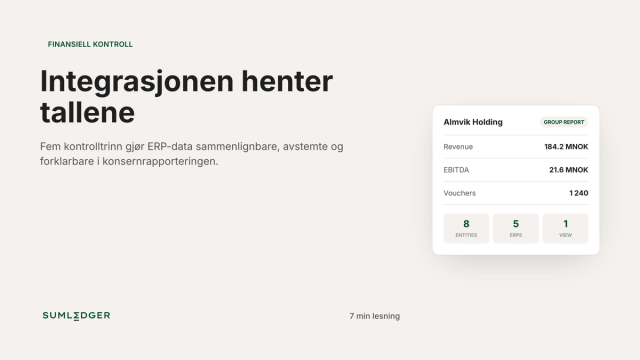
Five control steps that make ERP data comparable, reconciled and explainable in group reporting.

When AI changes the ledger: two control levels
An AI suggestion can be right locally and still distort the group view. Separate local accounting control from group control.