
Group reporting
Group finance reporting: 8 checks before sign-off
Sumledger · September 2, 2026
A practical CFO and controller sign-off: eight checks that make group numbers comparable, traceable and explainable.

A group report is not ready simply because every entity has submitted numbers. Before the CFO signs off, the finance team needs to know that periods, accounts, dimensions, currencies, intercompany items and variances have been handled consistently enough to make the group number comparable and explainable.
This checklist is designed for private groups with several entities, often across multiple ERP or accounting systems. It works whether reporting is managed in Excel, an ERP, or a dedicated control layer.
What should be checked before group reporting sign-off?
Before sign-off, the CFO or controller should check eight areas: submission status, period consistency, account mapping, dimensions, currency, intercompany items, variances and traceability. The goal is not merely a report that adds up, but a report whose material numbers can be explained.
1. Has every entity submitted the same reporting period?
Confirm that every entity has completed the same period at the same level of maturity. One subsidiary may have submitted August results while another still has an open bank reconciliation or accruals to post.
Check the period submitted, whether it is closed, whether material reconciliations are complete, and who approved the local submission. A simple entity status distinguishes a report that is ready from one that is merely populated.
2. Are local accounts mapped to the correct group structure?
The integration retrieves the numbers. Account mapping makes them comparable.
Two entities may record the same cost in different accounts. An acquired subsidiary may also have a chart of accounts shaped by another industry or local requirements. Review new accounts, unmapped accounts, mapping changes and unusual movement between reporting lines.
Mapping should be documented and owned by the finance team. It is group reporting logic, not just technical integration setup.
3. Are dimensions and reporting hierarchies comparable?
Departments, projects and cost centres make reporting useful, but they can create false precision when definitions differ between entities. One company may use “Sales” as a department, another may use regions, and a third may allocate the same costs to projects.
Review new or blank dimension values and hierarchy changes. Ask whether the report reflects the group management model or simply repeats local posting choices.
4. Have currency and translation been treated consistently?
In a Norway–Sweden group, local reports may be correct while the group result is wrong because exchange rates, rate dates or translation methods differ.
Document the rates used for profit and loss and balance sheet items, the relevant dates, the treatment of translation differences, and whether comparatives follow the same method. Currency review matters especially after large movements, acquisitions or a change in reporting currency.
5. Have intercompany balances been reconciled before elimination?
Elimination starts with reconciliation. If entity A shows a receivable of NOK 500,000 and entity B shows a liability of NOK 470,000, eliminating both amounts does not resolve the difference.
Common causes include different posting dates, invoices in transit, currency effects, different account or counterparty coding, missing internal markers and local posting errors. Use Reconcile Before You Eliminate: 7 Checks for a detailed workflow. Material differences should be corrected or documented with an owner and plan before sign-off.
6. Are eliminations visible and auditable?
The report should distinguish submitted numbers from group numbers after elimination. The CFO needs to see what was eliminated, under which rule and with what effect.
Confirm that expected eliminations have run, manual entries have an explanation and owner, no item has been eliminated twice, period-on-period changes are traceable, and the report can be viewed before and after elimination.
7. Are material variances explained rather than merely flagged?
A red variance is not an explanation. A report becomes decision-ready when its most important movements have a cause, an owner and, where relevant, an action.
A practical controller scenario
Consider a private group with seven entities in Norway and Sweden. August personnel costs are 9% above budget. Three issues explain the movement:
- A Swedish entity posted a bonus accrual earlier than planned.
- A Norwegian entity introduced two new accounts that were mapped to the wrong reporting line.
- Currency effects were included in the variance but not separated.
Without drilldown, the CFO sees one large variance. With control from group line to entity, account and transaction, the controller can separate timing, mapping and currency. Only then can management judge whether the underlying cost level changed.
8. Can every material number be traced to its source?
Can the finance team move from a group number back to entity, account, dimension, transaction and voucher where the data is available?
Traceability shortens investigations and supports questions from management, boards, auditors and owners. It also reduces person dependency. If every question requires one controller to open one particular workbook, the report remains fragile even when the arithmetic is correct. See When ERP Reports Stop at the Company Boundary for why local reporting does not always provide group control.
A simple monthly sign-off
Bring the checks into one period sign-off:
Control area
Status
Owner
Evidence
Entity submissions
Ready / exception
Local finance owner
Close status
Account mapping
Ready / exception
Group Controller
Mapping log
Dimensions
Ready / exception
Controller
Change log
Currency
Ready / exception
Group Controller
Rate source
Intercompany items
Ready / exception
Entity owners
Reconciliation list
Eliminations
Ready / exception
Group Controller
Elimination log
Material variances
Explained / open
Budget owner
Commentary
Traceability
Verified / exception
Reporting owner
Sample check
This does not need to become a heavy enterprise project. Status, ownership and evidence should, however, be shared and repeatable.
When Excel is still enough
Excel can be a sound solution when the group is simple, the model is documented, intercompany activity is limited and reporting takes little time. The need changes when control becomes a separate job: more entities, multiple ERP systems, new accounts, manual eliminations and recurring questions about where numbers came from.
At that point, the finance team should consider a shared control layer supporting the path from source data to signed group report. See how financial control can work across companies and systems.
From a complete report to an explainable group number
A good sign-off confirms more than completed cells. It confirms comparable periods, controlled mapping, reconciled intercompany items, visible eliminations and explainable material variances.
That is the difference between delivering a report and controlling group finance.
Want to see how Sumledger can bring the control work together across entities, ERP systems and vouchers? Book a short demo.
Relevant to explore
Group reporting
Unify reporting and consolidation for growing groups across companies and systems.
Financial control
Start at group level and drill down to company, account, transaction and voucher where data is available.
Multi-ERP control
Give finance one shared control layer even when subsidiaries use different ERP and accounting systems.
Shared reporting
Work from a shared reporting basis across your companies. Data is imported every hour so CFOs and controllers can follow performance and investigate variances.
Make group reporting easier to control
See how Sumledger brings mapping, reconciliations, eliminations and drilldown together across entities and ERP systems.
Book a short demoRead next
Related articles
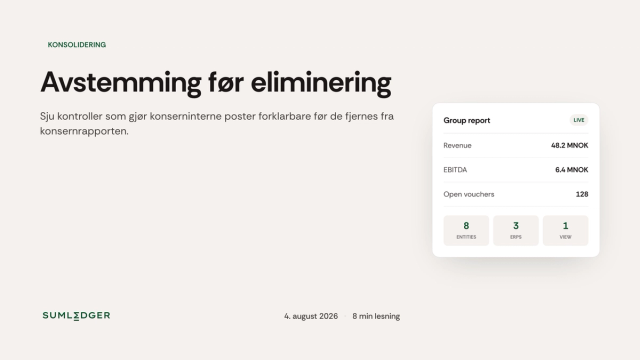
Reconcile Before You Eliminate: 7 Checks
Check counterparty, amount, period, mapping and documentation before eliminating intercompany balances.
When ERP Reports Stop At The Company Boundary
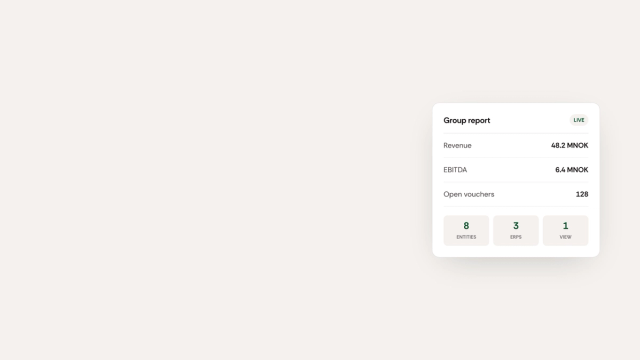
Local ERP reports may be trusted inside each subsidiary. The problem starts when finance needs to explain group numbers across companies.
Why Multi-ERP Groups Struggle With Reporting (And How to Fix It)
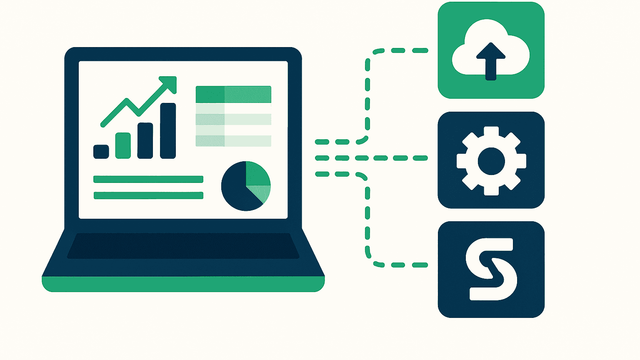
Different ERP systems bring different charts of accounts and reporting data. Sumledger helps groups bring accounting data into a shared model, with hourly imports. Account mapping and reporting logic are configured for the group, while Sumledger EXL brings the figures into Excel.