
Financial controlling
When AI changes the ledger: two control levels
Sumledger · August 25, 2026
An AI suggestion can be right locally and still distort the group view. Separate local accounting control from group control.

AI and automation can suggest coding, match documents and, in some systems, change accounting data. Yet an entry can be correct in one company and still distort the group view. CFOs and controllers therefore need two control levels: local accounting control and group control.
The first asks whether the entry is correct in the local entity. The second asks whether it is correctly understood, mapped and treated across the group.
Local correctness is not group correctness
An invoice may be approved, posted to the right local account and recorded in the correct period. Locally, the work is complete. Group reporting still needs to ask:
- Is the account mapped to the right group account?
- Do dimensions mean the same thing across entities?
- Is the counterparty identified if the transaction is intercompany?
- Should the entry be included in an elimination?
- Are currency and period handled consistently?
- Can the controller trace the group number to the transaction and voucher?
An AI suggestion can be correct under source-system rules but incomplete from a group perspective. The same distinction applies to rules-based automation, imports and manual bookkeeping. AI makes it more visible because more entries can move faster.
A CFO and controller scenario
Consider a private group with seven companies in Norway and Sweden using three accounting systems. A Norwegian entity invoices a Swedish sister company for development work.
The Norwegian system suggests a revenue account, department and project. The proposal is approved. In Sweden, the invoice is posted as an external consulting cost because the counterparty field does not carry across in the same way.
Both vouchers can be locally approved. The group still has three problems:
- The transaction is not marked consistently on both sides.
- Revenue and cost sit in different group categories.
- The elimination cannot be matched without manual knowledge.
Local posting control will not catch this. Group-level control of mappings, counterparties and eliminations will surface the difference before the board pack is complete.
Control level 1: Is the entry correct locally?
Local accounting control covers documentation and treatment within each entity.
Voucher and approval
Is there a valid document, and did the right person approve it? AI can help with extraction and suggestions, but ownership and approval must remain clear.
Account, tax and period
Is the entry on the correct local account, with the right tax treatment and period? A suggestion should be explainable, especially when the amount or account differs from the normal pattern.
Dimensions and access
Are department, project and cost centre correct? Who could suggest, change and approve the entry? The audit trail is part of control, not merely a technical log.
Once these checks pass, the entry may be correct locally. Group reporting still needs a second checkpoint.
Control level 2: Is the entry correct in the group view?
Group control makes local data comparable and explainable across companies and systems.
1. Account mapping
Local charts of accounts can be correct without being identical. Each account needs a mapping to a group structure with consistent meaning. When an account changes locally, the finance team must know whether the mapping remains valid.
2. Shared dimension logic
Project, department and market may mean different things in different systems. The finance function must own the definitions before figures can be compared.
3. Counterparty and intercompany
Intercompany entries must be identifiable on both sides through counterparty, account, dimension, project or another consistent marker. Without identification, matching and elimination become uncertain.
4. Period and currency
A correct local date is not always enough. Different close dates, accruals and exchange rates can create differences visible only at group level.
5. Reconciliation and elimination
Elimination should follow reconciliation, not conceal a difference. Find the cause first. Then document what was eliminated, under which rule and by whom.
6. Traceability to the voucher
A CFO needs more than a consolidated number. When something moves, the controller should be able to trace the group total to entity, account, transaction and voucher where the data supports it.
See also When ERP reports stop at the company boundary and Reconcile before elimination: seven checks.
Build a controlled workflow
A practical workflow has six steps:
- Define what the system may do. Separate suggestion, approval and posting.
- Preserve local evidence. Keep the voucher, rationale, user and timestamp traceable.
- Translate into group logic. Check account, dimension, counterparty, period and currency against shared rules.
- Run exception and intercompany checks. Prioritise entries that break patterns or fail to match.
- Approve eliminations and adjustments. Make the rule, owner and change visible.
- Explain the reporting impact. Show how the entry affects profit, balance sheet and reporting package.
This is not about manually reviewing every entry. It directs human attention to the exceptions that can change the group picture.
When are two control levels necessary?
The need is clearest in groups with several entities, multiple ERP or accounting systems, different charts of accounts, material intercompany activity or a close dependent on manual spreadsheets.
For a simple group with few internal transactions and a stable, documented model, the current process may be sufficient. The point is not that every group needs another system. The point is that local automation is not evidence that the group number has been controlled.
AI shifts control work; it does not remove it
As AI and automation handle more registration, controllers can focus more on exceptions, comparability and explanation. That can mean less repetitive work and more attention on entries that affect decisions.
The benefit depends on owning both levels. Local correctness produces a sound entity ledger. Group control makes figures comparable, eliminable and explainable to CFOs, boards and owners.
Sumledger gives CFOs and controllers one shared control layer across companies, ERP systems and vouchers. See how Sumledger supports financial control across the group, or book a short demo to compare the workflow with your group structure.
Relevant to explore
Financial control
Start at group level and drill down to company, account, transaction and voucher where data is available.
Group reporting
Unify reporting and consolidation for growing groups across companies and systems.
Multi-ERP control
Give finance one shared control layer even when subsidiaries use different ERP and accounting systems.
ERP integrations
Import accounting data from the systems your companies already use. Sumledger imports data every hour. Available data depends on the integration and setup.
Control the path from voucher to group number
See how Sumledger gives CFOs and controllers one shared control layer across companies, ERP systems and vouchers.
Book a short demoRead next
Related articles
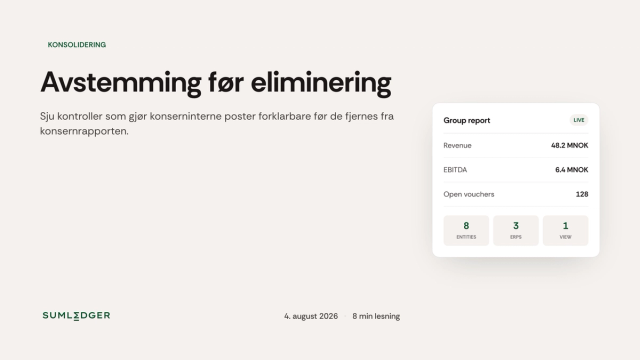
Reconcile Before You Eliminate: 7 Checks
Check counterparty, amount, period, mapping and documentation before eliminating intercompany balances.
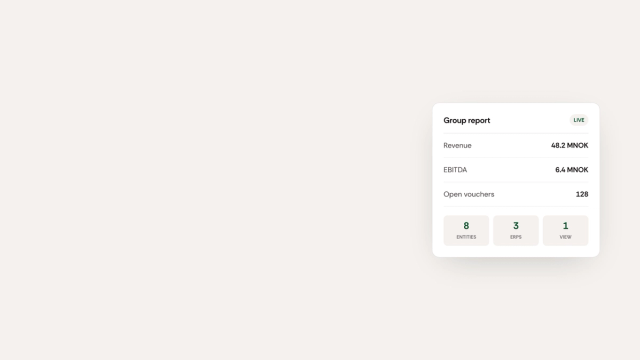
When ERP Reports Stop At The Company Boundary
Local ERP reports may be trusted inside each subsidiary. The problem starts when finance needs to explain group numbers across companies.

Why Multi-ERP Groups Struggle With Reporting (And How to Fix It)
Different ERP systems bring different charts of accounts and reporting data. Sumledger helps groups bring accounting data into a shared model, with hourly imports. Account mapping and reporting logic are configured for the group, while Sumledger EXL brings the figures into Excel.