
Group reporting
Group Finance Reporting For Private Groups
Sumledger · June 23, 2026
A practical guide for CFOs and controllers moving from local ERP reports and Excel to shared group control.

As a private group grows from three companies to six or ten, finance reporting changes character. The CFO still needs income statement, balance sheet and cash flow reporting. The controller still needs accounts, dimensions and vouchers. But the larger question becomes:
Can the finance team explain the group number across entities, accounting systems and manual adjustments?
This is where many groups reach the limits of local ERP reports and Excel. Local systems may show reliable company-level numbers. Excel gives flexibility. But group finance reporting requires a shared understanding of how numbers connect at group level.
Short Answer: Group Reporting Is More Than A Report
Group finance reporting for private groups is the process of collecting, mapping, reconciling and explaining finance data across entities. A useful report does not only show the group number. It makes it possible to trace the number back to entity, account, dimension, transaction, voucher and elimination where data is available.
For CFOs in private Nordic groups, the goal is rarely to build a heavy enterprise EPM environment. The practical goal is fewer manual exports, less person dependency, better month-end control and a reporting package that the board, owners and bank can trust.
Scenario: Six Companies, Three Systems And One Board Pack
Imagine a Norwegian group with six companies. Four are in Norway, one is in Sweden and one has recently been acquired in Denmark. The group uses Tripletex in two companies, Business NXT in the parent company and Fortnox in Sweden. The Danish company arrives with its own chart of accounts and an Excel reporting file.
Every month, the controller collects numbers, updates the group file, checks intercompany items, maps accounts, explains variances and prepares the board pack. The process works because one person knows the files, exports and exceptions.
Then the questions arrive:
- Why is EBITDA below budget in Sweden?
- Which internal revenue has been eliminated this month?
- Are project margins comparable across entities?
- Which vouchers explain the increase in external consulting costs?
- Can the bank get the same reporting package next quarter, but with a slightly different structure?
This is not only a reporting problem. It is a control problem.
Where ERP Reports Stop
Local ERP and accounting systems matter. They are the source for accounting data, vouchers and local reports. The issue starts when the CFO needs control over the group as a whole.
An ERP report usually understands its own company well. It does not necessarily understand the group reporting model, account mapping, elimination logic or how an acquired entity should be compared with the rest of the group.
In practice, finance has to build the group logic somewhere else. Often, that place is Excel. Reporting lines, mapping, comments, adjustments and variance explanations all live in a spreadsheet.
Excel can be the right tool for a long time. But when Excel becomes the home of group logic, reporting becomes fragile. It is harder to see who changed what, which rules apply and whether next month’s report follows the same logic as last month’s.
See also: When ERP Reports Stop At The Company Boundary.
What Good Group Reporting Needs
A useful reporting process for private groups should cover more than finished PDFs or dashboard views.
A Shared Reporting Model
The group needs a shared model for reporting lines, accounts and dimensions. That does not mean every company must use the same chart of accounts. It means finance owns the translation from local structures to the group management model.
Without this, every monthly report becomes a new interpretation. With a shared model, reporting becomes more consistent, and new entities can be added with less friction.
Control Over Eliminations
Eliminations may be a small part of the finished report, but they often create a large part of the control work. Intercompany sales, internal loans, recharges and balances need to be handled in a way that can be explained later.
For smaller groups, this can start manually. As entities and transactions grow, the controller needs a clear workflow for what has been eliminated, why it was eliminated and which differences remain.
Traceability From Report To Detail
The board rarely asks for an account number. But when a number moves, the CFO needs to explain it. A report line is not always enough. Finance needs to move from group number to entity, account, dimension, transaction or voucher where data exists.
Traceability makes reporting more robust. It also gives the controller a better basis for finding errors, explaining movements and answering follow-up questions.
A Process More Than One Person Can Understand
Person dependency is one of the clearest signs that group reporting has become too manual. If only one controller understands the exports, mapping and adjustments, the group has operational risk.
A good reporting process makes the logic visible to more people in finance. Not everyone needs to do everything, but reporting should not stop when one key person is unavailable.
Excel, ERP Report Or Control Layer?
It helps to separate four levels:
Alternative
When it works
When it becomes weak
Local ERP reports
Single-company or simple local reporting
When the CFO needs a view across entities and systems
Excel
Flexible analysis and small groups
When the file becomes the control system
BI/dashboard
Visualization of defined data
When finance must handle mapping, eliminations and traceability
Control layer
Shared finance control across entities
Requires clear rules and usable source data
The point is not that one option is always wrong. The point is to see when the job has changed. A group that needed reports yesterday may need control today.
A Practical Checklist For CFOs And Controllers
Use these questions to assess your reporting process:
- Can we report across all entities without manual export exercises every month?
- Do we have documented rules for account mapping and reporting lines?
- Are dimensions such as project, department and cost center comparable enough across entities?
- Do we know which intercompany items have been eliminated?
- Can we explain material variances down to entity, account or voucher where data exists?
- Can more than one person update and quality-assure the reporting package?
- Is Excel an analysis tool, or has Excel become the control system?
If several answers are unclear, the issue is rarely that finance lacks reports. The issue is that the reports do not connect in one shared control layer.
Where Sumledger Fits
Sumledger is built for private Nordic groups that have outgrown pure Excel reporting, but do not need a heavy enterprise EPM system.
Sumledger does not replace local ERP or accounting systems. It connects to existing systems and gives CFOs and controllers one shared control layer for group reporting, financial control, consolidation, eliminations, Excel workflows and analysis across entities.
Where data is available, finance can work from reporting lines down toward accounts, dimensions, transactions, vouchers and attachments. That makes it easier to explain the numbers, not only present them.
See also: SAF-T Standardizes Data. Not Group Control. and When Is Excel No Longer Enough For Group Reporting?.
Conclusion
Group finance reporting for private groups is not only about collecting numbers. It is about making those numbers manageable.
As a group adds entities, accounting systems and reporting requirements, each local system can only show part of the picture. The CFO needs a shared model, traceability, elimination control and a process the finance team can own together.
Excel and ERP reports can still be useful. But they should not be the only place where group control lives.
See how Sumledger can bring group reporting together across companies, accounting systems and vouchers. Book a short demo when you want to see the workflow in practice.
Relevant to explore
Group reporting
Unify reporting and consolidation for growing groups across companies and systems.
Multi-ERP control
Give finance one shared control layer even when subsidiaries use different ERP and accounting systems.
Financial control
Start at group level and drill down to company, account, transaction and voucher where data is available.
ERP integrations
Connect Sumledger to Fortnox, Business NXT, Tripletex, PowerOffice Go and more. Your numbers flow in automatically – no exports, no copy-paste, no delays.
See how group reporting can come together
Get a short walkthrough of how Sumledger gives CFOs and controllers one shared control layer across companies, accounting systems, eliminations and vouchers.
Book a short demoRead next
Related articles
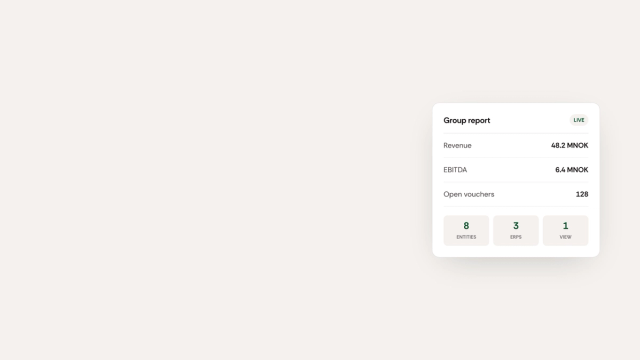
When ERP Reports Stop At The Company Boundary
Local ERP reports may be trusted inside each subsidiary. The problem starts when finance needs to explain group numbers across companies.
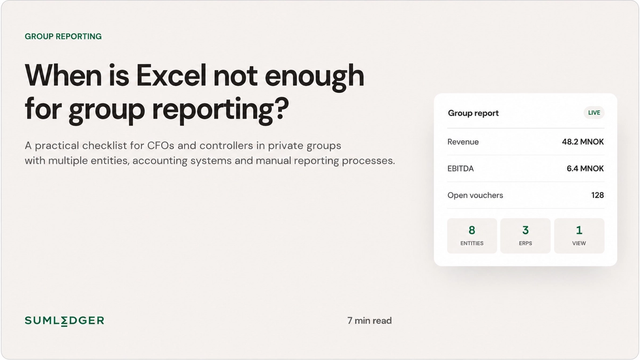
When Is Excel No Longer Enough For Group Reporting?
Excel can be the right starting point for group reporting. These are the signs that finance needs more structure, traceability and shared control.
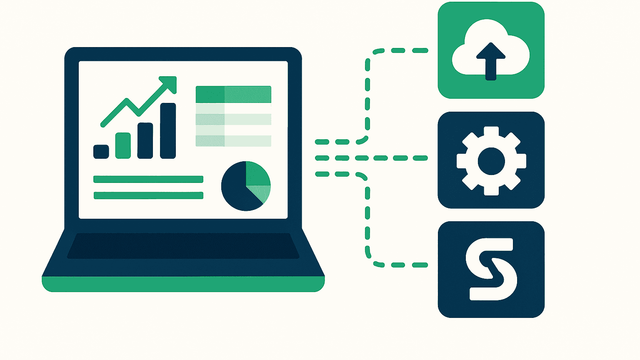
Why Multi-ERP Groups Struggle With Reporting (And How to Fix It)
A practical approach to account mapping, intercompany entries and variance analysis across different accounting systems.